
SEM
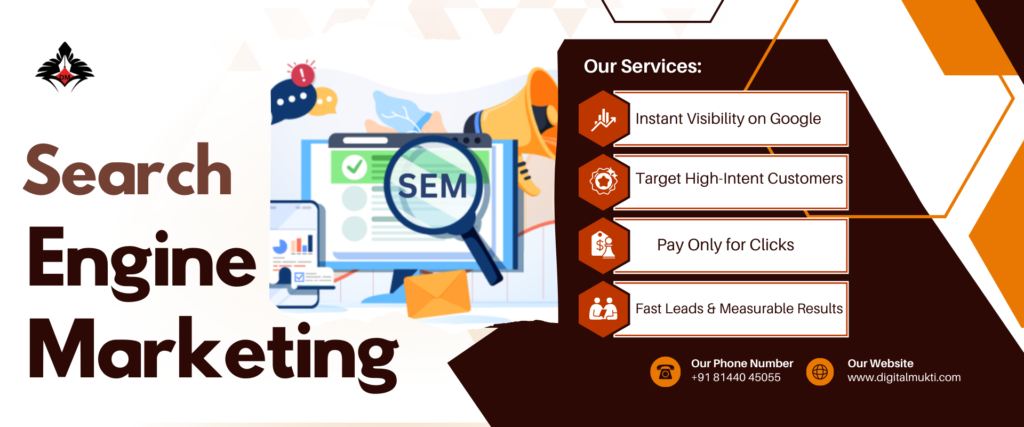
Search Engine Marketing, commonly known as SEM, is a digital marketing strategy used to promote websites by increasing their visibility on search engine results pages through paid advertising. Whenever a user searches for something on Google and sees ads at the top or bottom of the page, those ads are a result of SEM. In today’s competitive digital world, SEM plays a crucial role in helping businesses reach their target audience instantly. For students learning digital marketing practically, understanding SEM is important because it allows them to drive fast traffic, generate leads, and get measurable results in a short time.
SEM mainly works on the concept of showing ads to users who are already searching for a product or service. This makes SEM highly powerful and intent-based. For example, if someone searches “best digital marketing course,” and your ad appears at the top, there is a high chance that the user is genuinely interested. Unlike organic methods that take time, SEM provides immediate visibility and results. This is why businesses use SEM when they want quick traffic, promotions, or sales.
The most popular platform for SEM is Google Ads. Through Google Ads, advertisers bid on specific keywords that users search for on Google. When a search happens, Google runs an auction and decides which ads will appear and in what order. This decision is not based only on how much money an advertiser bids, but also on ad quality, relevance, and expected user experience. This means even small businesses can compete with big brands if their ads and landing pages are relevant and well-optimized.
Understanding keywords is the foundation of SEM. Keywords are the search terms users type into search engines. In practical SEM learning, students must know how to research keywords properly. Good keyword selection ensures that ads are shown to the right audience. There are different types of keywords such as broad match, phrase match, and exact match, each controlling how closely the user’s search must match the keyword. Choosing the right keyword type helps in controlling ad spend and improving conversion rates.
Another important aspect of SEM is ad copy creation. An ad copy includes the headline, description, and call-to-action that users see on the search results page. A good ad copy should be clear, relevant, and compelling. It should address the user’s problem and offer a solution. For example, using phrases like “Free Demo,” “Limited Offer,” or “Enroll Today” can increase clicks. Teaching students to write effective ad copies helps them understand customer psychology and improve campaign performance.
SEM does not end with creating ads; landing pages play a very important role. A landing page is the page where users arrive after clicking an ad. For SEM to be successful, the landing page must match the promise made in the ad. If the ad talks about a digital marketing course, the landing page should clearly explain the course, benefits, testimonials, and include a strong call-to-action. A slow, confusing, or irrelevant landing page can increase bounce rate and waste ad budget. Practically teaching students how to connect ads with optimized landing pages is essential.
Budget management is another practical component of SEM. Advertisers can control how much they spend daily or monthly. SEM works on a pay-per-click model, meaning you only pay when someone clicks on your ad. This makes SEM cost-effective if managed properly. Students should learn how to set budgets, monitor spending, and adjust bids based on performance. Understanding metrics like cost per click, click-through rate, and conversion cost helps in making informed decisions and improving return on investment.
Tracking and measurement are what make SEM powerful and practical. Platforms like Google Ads and Google Analytics allow marketers to track every action, from clicks to conversions. This data helps marketers understand what is working and what is not. Students should be trained to read reports, analyze performance, and optimize campaigns. SEM is not a one-time setup; it requires continuous testing, improvement, and scaling to achieve the best results.
SEM is especially useful for website promotion. A newly launched website usually does not rank immediately on search engines organically. SEM helps drive targeted traffic to such websites from day one. This is why SEM is often used along with SEO. While SEO focuses on long-term organic growth, SEM provides quick visibility and data that can also be used to improve SEO strategy. Teaching students this balance gives them a complete understanding of search marketing.
In real-world digital marketing, SEM is used for lead generation, e-commerce sales, event promotions, app downloads, and brand awareness. Whether it is a small local business or a large company, SEM can be customized according to business goals. Students who learn SEM practically gain confidence in running ads, managing budgets, and delivering measurable results to clients or businesses. It also opens career opportunities as performance marketers, media buyers, or freelancers.
In conclusion, Search Engine Marketing is a powerful and result-driven digital marketing technique that helps businesses grow online quickly. It focuses on showing relevant ads to users who are actively searching for solutions, making it highly effective. For students learning digital marketing practically, SEM teaches valuable skills such as keyword research, ad creation, landing page optimization, budget control, and performance analysis. By mastering SEM, students not only learn how to promote websites effectively but also understand how data, strategy, and psychology work together in digital marketing. SEM is not just about running ads; it is about creating smart, profitable campaigns that deliver real business results.